How Easy Are Megalodon Teeth to Find
Megalodon Quick Facts
Are Megalodon Teeth Common Fossils?
Megalodon teeth are relatively common fossils in many locations. The reasons for this is that the Megalodon (and other sharks) shed their teeth during their lifetime or as they grew. An adult Megalodon likely would shed several thousands teeth during its lifetime.
Teeth also tend to fossilize pretty easily. Larger teeth tend to much rarer as there were progressively fewer larger sharks than smaller ones, and the vast majority of fossil Megalodon teeth that are found are not complete or damaged. So, while Megalodon teeth are common, large, good quality specimens can be very rare.
Most fossil Megalodon teeth that are found are relatively small, maybe around 2-3 inches long. A Megalodon was not born with massive 6 inch teeth but rather shed and replaced there teeth with progressively larger ones as they grew. Since few sharks would have survived to adulthood, there would be far more small Megalodon teeth than large ones.
Why Do Fossil Megalodon Teeth Come In So Many Different Colors?
The color of a fossil shark tooth has nothing to do with the original color of the teeth which would have been white like modern day shark teeth. The color comes from the minerals that replaced the tooth during the fossilization process or leached into the tooth post fossilization. Coloration tends to be distinctive to different collecting localities due to mineral content in the ground or natural processes that the fossil has undergone post fossilization. For example teeth collected from water tend to be less colorful (straight black or tan) because the water has leached minerals from the tooth over thousands of years. Find out more…
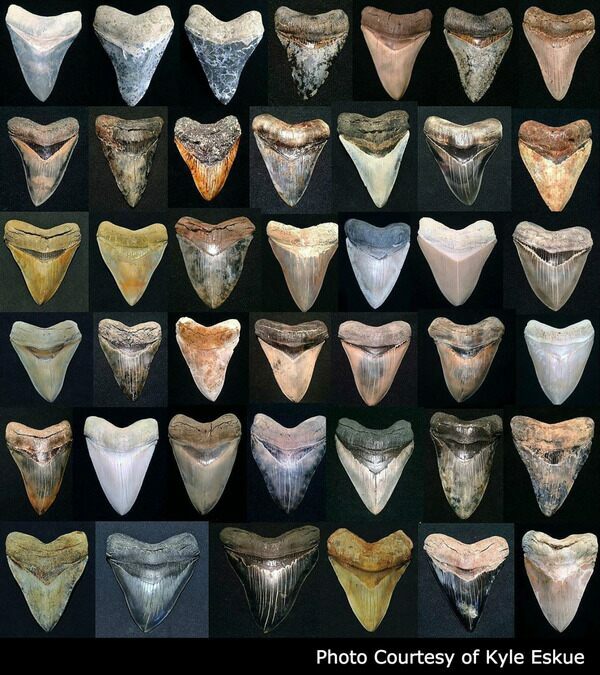
Megalodon teeth can exhibit a very wide range of colorations which are often very distinctive to the locality at which they are found.
How Are Megalodon Teeth Measured?
Megalodon teeth are always measured using the diagonal length from the corner of the root to the tip of the tooth. The longer of the two diagonals is the length of the tooth. I always use digital calipers to get measurements to the 1/100th of an inch as small changes in tooth size can have a big impact in price with large teeth.
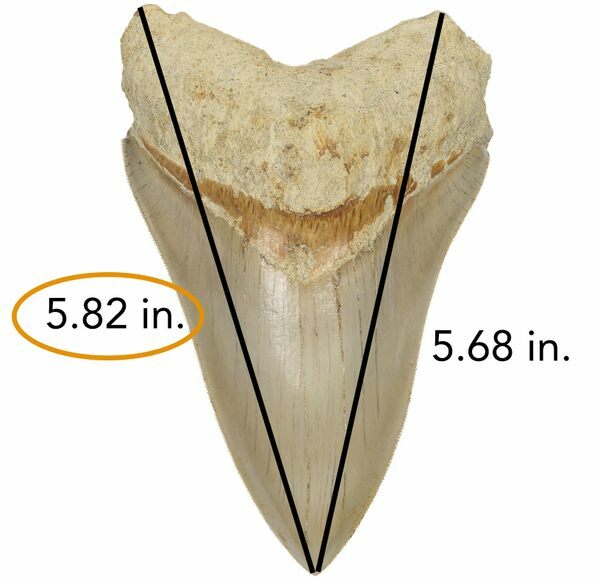
Megalodon teeth are measured on the diagonal from top to root lobe.
Buyers Guide: How Much Are Megalodon Teeth Worth?
I have gotten several times lately from customers wondering about the pricing on Megalodon teeth. Why is that 6 inch tooth less than the 5 1/2 inch tooth that you are selling? Shouldn't it be more expensive? Fossils are all unique, so of course pricing is a little subjective but there are many factors that go into putting a price on a Megalodon tooth.
Size
All other factors being equal the larger the tooth the more it is worth. Teeth get progressively more rare as size increases, so the price also increases. Once you start to get around 4-5 inches this price increase starts to become exponential, as the larger teeth are more difficult to find. Particularly as you near the magical size of 6 inches (a very large tooth) it climbs fast. A 6 inch tooth will often sell for more than twice as much as a comparable 5 ¾ inch tooth.
While there have been Megalodon teeth over 7 inches found they are exceedingly rare. Only a handful of 7 inches have EVER come on the market and the last one I saw for sale was several years ago with an asking price well north of $25k.
A note on size measurements. Megalodon teeth are always measured using the diagonal length from the corner of the root to the tip of the tooth. The longer of the two diagonals is the length of the tooth. I always use digital calipers to get measurements to the 1/100th of an inch as small changes in tooth size can have a big impact on price with large teeth.
Location Collected
Just like with real estate, it's all about location. While this may not matter if you are just buying a Megalodon tooth as a present for a kid or to display on your shelf, it is very important to collectors. Complete Megalodon teeth are common from some locations, but very rare from others. If a site becomes inaccessible to collecting, for example the closing of the Lee Creek Mine, prices jump.
In general teeth from the river and ocean deposits in the Carolinas are the least expensive while teeth from land sites such as Bakersfield are much more rare. Different sites also tend to produce unique colorations, modes of preservation and sizes. A 4 inch Megalodon teeth from the Carolinas are relatively common while a 4 inch tooth from the Bone Valley region of Florida is quite rare.
Tooth Condition:
The overall condition of the tooth has a big impact on pricing. A "perfect" tooth (does perfect really exist?) with no flaws is very rare, so the price will many times higher than a tooth with just a few minor flaws. Most collectors will value condition above all else while someone just buying a tooth as a gift for their kid may not find the condition as important as size.
Enamel – How much of it is present and what condition is it in? It's common for larger teeth to have significant amounts of peeled enamel.
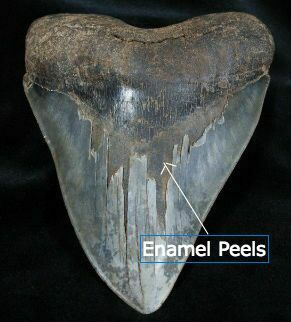
Megalodon tooth with enamel peels.
Root Condition – Is it complete? It's very common for portions of the root to be worn away.
Serrations – Are they visible and complete? How sharp or worn are they?
Tip – Is the tip worn? Does it have feeding damage? Teeth with a sharp tip are the exception, so it adds a lot to the price.
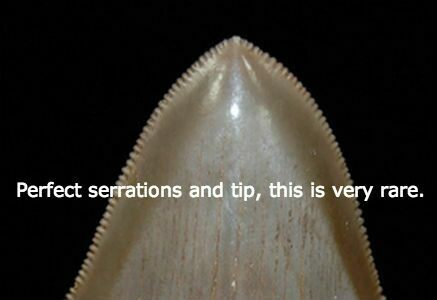
Tooth with perfect serrations and tip>
Chipping – Are there chips out of the edge of the blade?
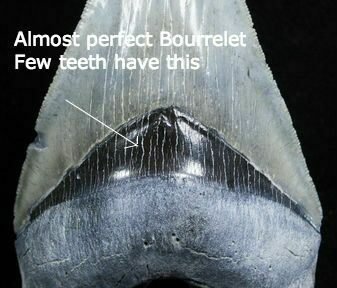
Bourrelet – The bourrelet is a thin band of enamel between the blade and the root. It is worn is the vast majority of teeth so having a complete or near complete bourrelet is rare.
Restoration and Repair
Repair refers to gluing a broken tooth back together to make it whole again. Restoration is reconstructing a missing portion of the tooth, often done with the root or portions of enamel. Both of these type and degree of these alterations affect the price of the tooth.
For some minor amounts of restoration to make a tooth look better is not a big deal, while for others it is a deal breaker. A 5 inch Megalodon tooth with part of the root restored might be ½ or 1/3 the cost of one with no restoration. Some people would rather have a tooth that looks the same at 1/3 the cost.
It's important to know what you are buying. Some of the teeth I sell have been restored or repaired but I always clearly note this in the descriptions, and the prices reflect the alterations. Unfortunately not all sellers are upfront about this, and some are simple dishonest even when asked.
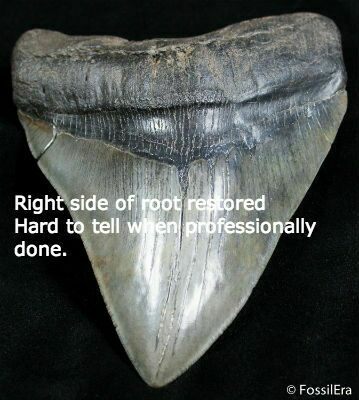
Tooth with right side of root restored.
Polishing/Buffing
One process often used to clean Megalodon teeth is to buff it to clean the surface and this will often add a little shine to the enamel too. This is something considered acceptable by most collectors and the cleaning if done well will usually increase the value of a tooth.
But, "polishing" a tooth on the other hand is where the tooth is heavily polished to the point of removing enamel in order to hide surface defects. You can take a pretty gnarly tooth and polish it to make it look semi-attractive. Because this process is in effect doing significant damage to the tooth, the tooth would be far less valuable than an unpolished tooth. Most collectors aren't interested in polished teeth.
Unique Coloration - Sometimes a tooth will have a unique coloration for the site it was found and these teeth will command premiums.
Shape & Location In Mouth - The location the tooth was in the mouth of the sharp determines the shape. Lower teeth will be dagger shaped while posterior teeth will be short and wide. Some collectors prefer different shaped teeth.
Growth Pathologies - Anything that makes a tooth unique and rarer can make it more valuable to collectors. Pathologies or deformations that happened while the shark was alive can make a tooth for valuable. There are collectors that specialize in collecting Megalodon teeth with pathologies.
10 Killer Megalodon Shark Facts
Fact #1. The Megalodon Shark Was The Largest Shark That Ever Lived.
Reaching lengths of up to 60-70 feet and an estimated maximum weight of over 60 tons, the Megalodon is the largest known shark in Earth's history. To compare this size, the largest modern Great White sharks max out around 23 feet and 3 ½ tons. This makes the Megalodon nearly 3 times as long, and 20 times and heavy as the Great White Shark.
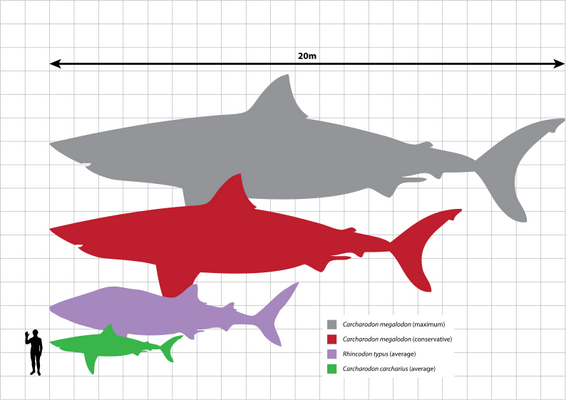
Megalodon size compared with a Whale Shark, modern Great White Shark and human.
The Megalodon's massive size also dwarfs that of the large, extinct marine reptiles like the Mosasaurus, Tylosaurus and Liopleurodon on a weight basis.
Because shark skeletons are made of cartilage that doesn't fossilized easily, scientists just have the teeth to go on when estimating maximum size. This has caused a wide range of maximum sizes to be proposed over the years, depending on the methodology used, but most scientifically accepted maximum sizes fall in the 50-60 foot range.
Fact #2. The Megalodon's Teeth Could Reach Sizes Over 7 Inches
While most adult Megalodon teeth fell into the 4-5" size range, a few massive, fossil teeth have been found in excess of 7" The largest verifiable Megalodon tooth is a 7.48" tooth found near Ocucaje, Peru. Compare that to the Great White shark whose teeth reached a maximum size of under 3 inches in the largest individuals. Reconstructions of the Megalodon's jaw suggest they may have been up to 7 feet across.
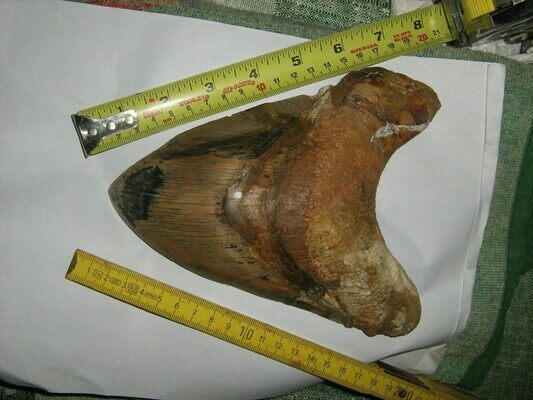
Largest verifiable Megalodon tooth at 7.48" long. Photo credit Craig Sundell
Fact #3. The Megalodon Is NOT Closely Related To The Great White Shark
Contrary to popular belief, fossil evidence shows that the Megalodon is NOT in fact closely related to the Great White Shark. When the Megalodon was first described based on fossil teeth in 1843, it was put in the same genus as the Great White shark, Carcharodon. They both had big, serrated teeth and were the marine apex predators of their time. So they must be related, right? But, as our understanding of shark taxonomy has grown and new fossil discoveries have filled gaps in the fossil record, it's become apparent this assumption was not correct and a new Carcharocles genus was created. An even more recent study has reclassified the Megalodon yet again into the Otodus genus.
The Megalodon likely represented the end-point in a chronospecies, or a single evolutionary line that can be traced back nearly 60 million years to the Otodus shark. At the same time the research has shown that the Mako Shark and Great White Shark and closely related. Fossils show that they both likely evolved from the extinct Broad Tooth Mako (Isurus hastalis), branching off about 5 million years ago. So, while popular media often represents that the Megalodon and Great White are closely related, that statement doesn't match the fossil evidence or the consensus view among researchers.
Fact #4. The Megalodon Ate Whales For Breakfast
This gigantic shark obviously required a massive amount of food and it's been estimated an adult Megalodon may have had to consume over a ton of food per day to sustain itself. Fossil evidence points to the Megalodon preying on whales and other large marine mammals such as Sea Cows and Sea Lions.
Many fossil whale bones have been found with clear signs of large, bite marks made by teeth matching the Megalodon's Other excavations have found Megalodon teeth lying next to the chewed remains of whales.
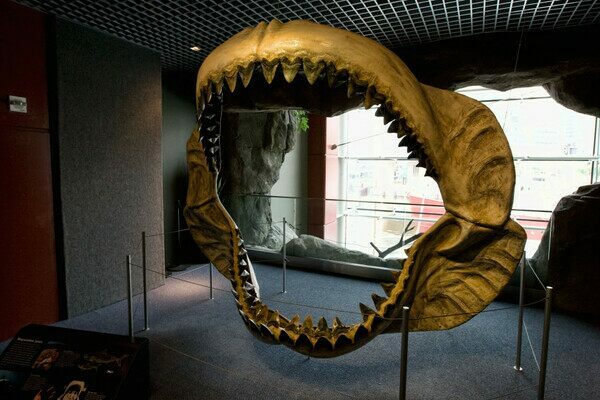
Reconstructed Megalodon jaw at the National Aquarium in Baltimore
Fact #5. Teeth Are Relatively Common Fossils
Surprising to some, fossil Megalodon teeth are relatively common fossils in many areas of the world. Like other sharks the Megalodon lost it's teeth as it grew, they became worn or broken. Their teeth also were very solid and fossilized quite easily. While Megalodon teeth in general can be quite common, large or exceptionally well preserved specimens can be very rare, and can fetch big bucks from collectors. For example, 7" Megalodon teeth are so rare, the last one sold for nearly $50k, while small or broken teeth can be quite inexpensive.
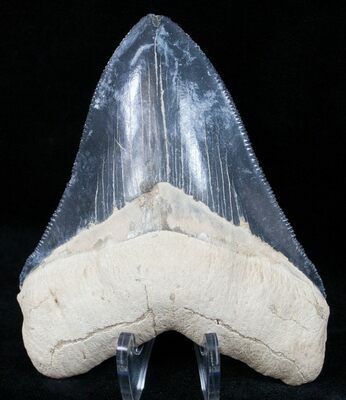
Colorful Bone Valley, Florida Megalodon Tooth
Fact #6. The Megalodon Had A Cosmopolitan Or World-Wide Distribution
Fossil teeth of the Megalodon have been found world wide from regions including North and South America, Europe, Africa, as well as Puerto Rico, Cuba, Jamaica, the Canary Islands, Australia, New Zealand, Japan, Malta, Grenadines and India. It appears to have lived anywhere the ocean was warm enough and food sources plentiful enough to sustain it.
Fact #7. The Megalodon Went Extinct Around 2.6 Million Years Ago
Unless you believe a bunch of CGI, made up "evidence" and actors masquerading as scientists on the Discovery channel the Megalodon shark extinct around 2.6 million years ago. During this time, the Earth underwent significant climate changes which would have but significant pressures on the Megalodon. The Oceans cooled and sea levels dropped, and many large marine mammals which the Megalodon relied on for food disappeared during this approximate time.
Fact #8. The Megalodon Had The Most Powerful Bite of Any Known Animal
The Megalodon is believed to have had the most powerful bite of any animal, and it's not even close. Computer models estimate the Megalodon's bite force between 24,000 to 40,000 pounds (10,900 to 18,100 kilograms), This is 6-10 times that of the Great White shark and modern crocodiles, This is also 2-3 times that of the estimated bite force of 12,800 pounds for T-Rex and the large Mosasaurs. This enormous bite force could literally bite a small whale in half.
Fact #9. Several Megalodon Nursery Areas Have Been Discovered
The Megalodon gave birth to it's young in shallow water environments. Several suspected nursery areas have been identified based on the high concentrations of small Megalodon teeth, many only about 1 ½ inches in length. These suspected nursery areas include the Bone Valley Region of Florida, the Calvert Cliffs in Maryland and the recently described nursery in the Gatum Formation of Panama.
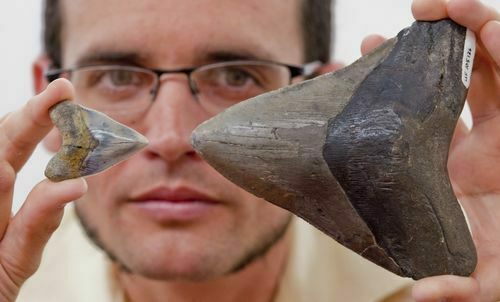
University of Florida vertebrate paleontology graduate student Dana Ehret holds a juvenile and adult Megalodon tooth up for comparison.
Fact #10. The Megalodon Had About 276 Teeth In 5 Rows
Like modern sharks, the Megalodon discarded it's teeth frequently as they became worn. It likely had 5 rows of teeth, which acted like a conveyer belt, so that lost teeth could be replaced rapidly, likely within 24-48 hours. While tooth loss rates are poorly understood even in modern-day sharks, it's likely that a Megalodon went through thousands of teeth during it's lifetime. The vast majority of fossil Megalodon teeth that are collected show significant feeding wear to the tip, someones with the tips completely sheered off due to hitting bone or other teeth during feeding.
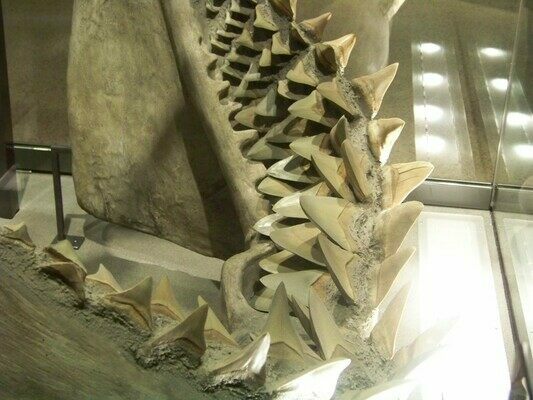
Reconstructed Megalodon jaw showing rows of teeth that would act as replacements for damaged teeth.
Source: https://www.fossilera.com/fossils-for-sale/fossil-megalodon-teeth
0 Response to "How Easy Are Megalodon Teeth to Find"
Post a Comment